


Hengli Heavy Industry Lands Another Mega Order for 52 Container Ships! MSC Likely to Take 20
Source:
2026-10-26
According to a post on the official WeChat account of Hengli Heavy Industry Group, the company has recently reached construction agreements with several well-known international container liner companies to undertake a total of 52 ultra-large dual-fuel container ships, including 20 19,000 TEU, 12 22,000 TEU, and 20 24,000 TEU vessels across three main ship types.
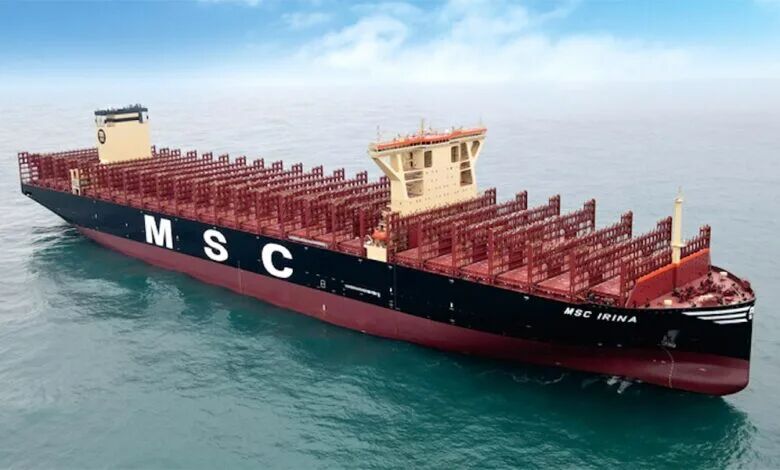
This batch of vessels will adopt LNG dual-fuel solutions and will all use LNG dual-fuel main engines and LNG fuel tanks independently developed and produced by Hengli Heavy Industry.
According to foreign media reports, the shipowner behind the 20 24,000 TEU container ships is very likely Mediterranean Shipping Company (MSC).
According to the latest weekly market report from liner consulting firm Linerlytica, this batch of new ships will add approximately 480,000 TEU of future capacity for MSC and increase its orderbook at Hengli Heavy Industry for ships of 20,000 TEU and above to 62 vessels.
Clarksons data shows that the latest 20 new ships were signed in September, with 15 scheduled for delivery in 2029 and the remaining 5 in 2030. The actual contract value of the new batch of ships has not yet been disclosed. Since the two sides signed a strategic cooperation agreement in 2024, MSC has developed a systematic construction pipeline at Hengli Heavy Industry: starting from an initial 10 21,000 TEU vessels and gradually expanding to the 24,000 TEU class.
The latest order adds considerable capacity to MSC's expansion plan, which already significantly leads its competitors. Alphaliner data shows that as of the end of September, MSC's operating fleet stood at about 7.4 million TEU, accounting for 21.5% of global liner capacity, with an additional 2.94 million TEU on order. Its fleet plus orderbook has exceeded 10 million TEU, firmly ranking first in the world, with a capacity scale clearly ahead of second-ranked Maersk (about 4.73 million TEU).
Meanwhile, global newbuilding commitments have climbed to their highest level in more than a decade. Linerlytica estimates that the global container ship orderbook has reached 16.2 million TEU, equivalent to 46.5% of the existing fleet, the highest ratio since 2009.
Hot News